A Short Musical Idea That Is Stated Over and Over Again Throughout a Section
In music, an ostinato (Italian: [ostiˈnaːto]; derived from Italian word for 'stubborn', compare English 'obstinate') is a motif or phrase that persistently repeats in the aforementioned musical voice, frequently in the same pitch. Well-known ostinato-based pieces include both classical compositions, such every bit Ravel's Boléro and the Carol of the Bells, and popular songs such equally Donna Summertime and Giorgio Moroder's "I Feel Love" (1977), Henry Mancini's theme from Peter Gunn (1959), The Who'south "Baba O'Riley" (1971), and The Verve's "Bitter Sweet Symphony" (1997).[ane] [2] [3]
Both ostinatos and ostinati are accepted English plural forms, the latter reflecting the discussion'southward Italian etymology.
The repeating thought may exist a rhythmic design, part of a tune, or a consummate melody in itself.[iv] Strictly speaking, ostinati should have exact repetition, just in common usage, the term covers repetition with variation and evolution, such as the alteration of an ostinato line to fit changing harmonies or keys.
If the cadence may exist regarded equally the cradle of tonality, the ostinato patterns tin can be considered the playground in which it grew strong and self-confident.
—Edward E. Lewinsky[v]
Within the context of picture show music, Claudia Gorbman defines an ostinato as a repeated melodic or rhythmic effigy that propels scenes that lack dynamic visual action.[6]
Ostinati play an of import office in improvised music (rock and jazz), in which they are oftentimes referred to as riffs or vamps. A "favorite technique of contemporary jazz writers", ostinati are often used in modal and Latin jazz and traditional African music including Gnawa music.[7]
The term ostinato essentially has the same meaning equally the medieval Latin word pes, the give-and-take footing equally applied to classical music, and the word riff in contemporary popular music.
Classical music [edit]
Ostinati are used in 20th-century music to stabilize groups of pitches, as in Stravinsky's The Rite of Spring Introduction and Augurs of Spring.[4] A famous type of ostinato, called the Rossini crescendo, owes its proper name to a crescendo that underlies a persistent musical pattern, which commonly culminates in a solo vocal cadenza. This style was emulated by other bel canto composers, especially Vincenzo Bellini; and later by Wagner (in pure instrumental terms, discarding the closing song cadenza).
Applicable in homophonic and contrapuntal textures, they are "repetitive rhythmic-harmonic schemes", more familiar as accompanimental melodies, or purely rhythmic.[eight] The technique'southward appeal to composers from Debussy to avant-garde composers until at to the lowest degree the 1970s "... lies in role in the need for unity created by the virtual abandonment of functional chord progressions to shape phrases and ascertain tonality".[8] Similarly, in modal music, "... relentless, repetitive character assistance to establish and confirm the modal eye".[7] Their popularity may also exist justified by their ease equally well equally range of use, though, "... ostinato must be employed judiciously, as its overuse can quickly lead to monotony".[7]
Medieval [edit]
Ostinato patterns have been present in European music from the Middle Ages onwards. In the famous English canon "Sumer Is Icumen In", the main vocal lines are underpinned by an ostinato pattern, known as a pes:

Later in the medieval era, Guillaume Dufay's 15th-century chanson Resvelons Nous features a similarly synthetic ostinato pattern, but this time 5 confined long. Over this, the principal melodic line moves freely, varying the phrase-lengths, while beingness "to some extent predetermined by the repeating pattern of the catechism in the lower two voices."[9]

Footing bass: Tardily Renaissance and Baroque [edit]
Ground bass or basso ostinato (obstinate bass) is a type of variation class in which a bass line, or harmonic design (see Chaconne; also common in Elizabethan England as Grounde) is repeated as the basis of a slice underneath variations.[ten] Aaron Copland[xi] describes basso ostinato as "... the easiest to recognize" of the variation forms wherein, "... a long phrase—either an accompanimental effigy or an actual melody—is repeated over and over again in the bass part, while the upper parts proceed normally [with variation]". However, he cautions, "it might more properly be termed a musical device than a musical form."
One striking ostinato instrumental piece of the belatedly Renaissance catamenia is "The Bells", a piece for virginals by William Byrd. Here the ostinato (or 'footing') consists of just two notes:

In Italy, during the seventeenth century, Claudio Monteverdi composed many pieces using ostinato patterns in his operas and sacred works. One of these was his 1650 version of "Laetatus sum", an imposing setting of Psalm 122 that pits a 4-notation "ostinato of unquenchable energy."[12] against both voices and instruments:

Later in the same century, Henry Purcell became famous for his expert deployment of basis bass patterns. His nigh famous ostinato is the descending chromatic footing bass that underpins the aria "When I am laid in earth" ("Dido's Lament") at the terminate of his opera Dido and Aeneas:
Purcell, Dido's Lament ground bass

Purcell, Dido's Lament ground bass
While the use of a descending chromatic scale to limited pathos was fairly common at the cease of the seventeenth century, Richard Taruskin points out that Purcell shows a fresh approach to this musical trope: "Altogether unconventional and feature, yet, is the interpolation of an additional cadential measure out into the stereotyped basis, increasing its length from a routine four to a haunting five bars, confronting which the vocal line, with its despondent refrain ("Remember me!"), is deployed with marked asymmetry. That, in addition to Purcell's distinctively dissonant, suspension-saturated harmony, enhanced by additional chromatic descents during the final ritornello and by many deceptive cadences, makes this footling aria an unforgettably poignant embodiment of heartache."[13] See also: Lament bass. However, this is not the merely ostinato pattern that Purcell uses in the opera. Dido'due south opening aria "Ah, Belinda" is a further sit-in of Purcell'due south technical mastery: the phrases of the vocal line practise not always coincide with the iv-bar ground:

"Purcell'due south compositions over a ground vary in their working out, and the repetition never becomes a restriction."[14] Purcell'due south instrumental music also featured ground patterns. A peculiarly fine and complex instance is his Fantasia upon a Ground for iii violins and continuo:

Purcell Fantasia in 3 parts to a ground
The intervals in the above blueprint are found in many works of the Baroque Menstruum. Pachelbel's Canon also uses a similar sequence of notes in the bass function:

Two pieces by J.S.Bach are specially striking for their use of an ostinato bass: the Crucifixus from his Mass in B minor and the Passacaglia in C modest for organ, which has a footing rich in melodic intervals:
Bach C modest Passacaglia ground bass

Bach C minor Passacaglia ground bass
The first variation that Bach builds over this ostinato consists of a gently syncopated motif in the upper voices:
Bach C small-scale Passacaglia Variation i

Bach C minor Passacaglia Variation 1
This characteristic rhythmic pattern continues in the 2d variation, but with some engaging harmonic subtleties, especially in the second bar, where an unexpected chord creates a passing implication of a related key:
Bach C modest Passacaglia Variation 2

Bach C small-scale Passacaglia Variation two
In mutual with other Passacaglias of the era, the ostinato is not merely confined to the bass, but rises to the uppermost part later in the piece:
Bach C small-scale Passacaglia variation with ostinato in treble
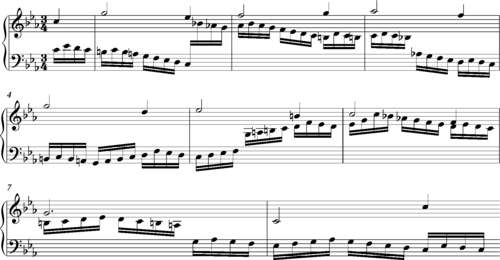
Bach C small Passacaglia with ostinato in treble
A performance of the entire piece can be heard here.
Tardily eighteenth and nineteenth centuries [edit]
Ostinatos characteristic in many works of the belatedly 18th and early on 19th centuries. Mozart uses an ostinato phrase throughout the big scene that ends Human action 2 of the Marriage of Figaro, to convey a sense of suspense equally the jealous Count Almaviva tries in vain to incriminate the Countess, his wife, and Figaro, his butler, for plotting behind his dorsum. A famous blazon of ostinato, called the Rossini crescendo, owes its name to a crescendo that underlies a persistent musical pattern, which unremarkably culminates in a solo vocal cadenza.
In the energetic Scherzo of Beethoven's late C abrupt minor Quartet, Op. 131, there is a harmonically static passage, with "the repetitiveness of a nursery rhyme"[15] that consists of an ostinato shared between viola and cello supporting a melody in octaves in the get-go and 2d violins:
Beethoven Op 131 Trio from Scherzo, bars 69–76
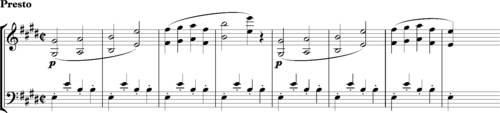
Beethoven Op 131 Trio from Scherzo, confined 69–76
Beethoven reverses this relationship a few bars later on with the melody in the viola and cello and the ostinato shared between the violins:
Beethoven Op 131 Trio from Scherzo, bars 93–100
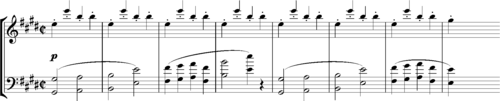
Beethoven Op 131 Trio from Scherzo, bars 93–100
Both the starting time and third acts of Wagner's final opera Parsifal characteristic a passage accompanying a scene where a band of Knights solemnly processes from the depths of forest to the hall of the Grail. The "Transformation music" that supports this change of scene is dominated by the iterated tolling of four bells:

Brahms used ostinato patterns in both the finale of his Fourth Symphony and in the closing section of his Variations on a Theme past Haydn:

Brahms Variations on a Theme by Haydn, final section with basis bass
Twentieth century [edit]
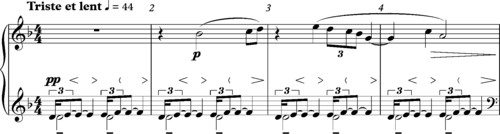
Debussy featured an ostinato pattern throughout his Piano Prelude "Des pas sur la neige". Here, the ostinato pattern stays in the middle register of the piano – it is never used as a bass. "Remark that the footfall ostinato remains nearly throughout on the aforementioned notes, at the same pitch level... this piece is an entreatment to the basic loneliness of all man beings, often-forgotten perhaps, but, like the ostinato, forming a basic undercurrent of our history."[sixteen]
Of all the major classical composers of the Twentieth Century, Stravinsky is perchance the one most associated with the exercise of ostinato. In chat with the composer, his friend and colleague Robert Craft remarked "Your music always has an element of repetition, of ostinato. What is the function of ostinato?" Stravinsky replied; "It is static – that is, anti-development; and sometimes we need a contradiction to development."[17] Stravinsky was particularly skilled at using ostinatos to derange rather than confirm rhythmic expectations. In the start of his 3 Pieces for String Quartet, Stravinsky sets up iii repeated patterns, which overlap one another and never coincide. "Here a rigid design of (3+2+2/4) bars is laid over a strictly recurring twenty-three-beat melody (the bars being marked by a cello ostinato), and so that their changing relationship is governed primarily past the pre-compositional scheme."[18] "The rhythmical current running through the music is what binds together these curious mosaic-similar pieces."[19]
A subtler metrical conflict can exist found in the final section of Stravinsky's Symphony of Psalms. The choir sing a melody in triple fourth dimension, while the bass instruments in the orchestra play a four-vanquish ostinato against this. "This is congenital upwards over an ostinato bass (harp, 2 pianos and timpani) moving in fourths like a pendulum."[20]
Sub-Saharan African music [edit]

Counter-metric structure [edit]
Many instruments south of the Sahara Desert play ostinato melodies.[ clarification needed ] These include lamellophones such as the mbira, as well as xylophones similar the balafon, the bikutsi, and the gyil. Ostinato figures are also played on cord instruments such as the kora, gankoqui bell ensembles, and pitched drums ensembles. Often, African ostinatos incorporate offbeats or cantankerous-beats, that contradict the metric construction.[21] Other African ostinatos generate complete cross-rhythms by sounding both the main beats and cross-beats. In the following example, a gyil sounds the three-against-two cantankerous-rhythm (hemiola). The left hand (lower notes) sounds the two main beats, while the right mitt (upper notes) sounds the three cantankerous-beats.[22]

African harmonic progressions [edit]
Popular dance bands in West Africa and the Congo region feature ostinato-playing guitars. The African guitar parts are fatigued from a variety of sources, including the indigenous mbira, every bit well as foreign influences such as James Chocolate-brown-type funk riffs. However, the strange influences are interpreted through a distinctly African ostinato sensibility. African guitar styles began with Congolese bands doing Cuban "cover" songs. The Cuban guajeo had a both familiar and exotic quality to the African musicians. Gradually, various regional guitar styles emerged, as indigenous influences became increasingly dominant within these Africanized guajeos.[23]
Every bit Moore states, "1 could say that I – IV – 5 – 4 [chord progressions] is to African music what the 12-bar blues is to Northward American music."[24] Such progressions seem superficially to follow the conventions of Western music theory. However, performers of African popular music exercise not perceive these progressions in the same way. Harmonic progressions which motility from the tonic to the subdominant (as they are known in European music) take been used in Traditional sub-Saharan African harmony for hundreds of years. Their elaborations follow all the conventions of traditional African harmonic principles. Gehard Kubik concludes:
The harmonic cycle of C–F–G–F [I–Iv–Five–IV] prominent in Congo/Zaire popular music simply cannot be defined as a progression from tonic to subdominant to dominant and back to subdominant (on which it ends) because in the performer's appreciation they are of equal status, and not in any hierarchical society as in Western music—(Kubik 1999).[25]
Afro-Cuban guajeo [edit]
A guajeo is a typical Cuban ostinato melody, near oft consisting of arpeggiated chords in syncopated patterns. The guajeo is a hybrid of the African and European ostinato. The guajeo was start played as accompaniment on the tres in the folkloric changüí and son.[26] The term guajeo is often used to hateful specific ostinato patterns played by a tres, piano, an instrument of the violin family, or saxophones.[27] The guajeo is a cardinal component of mod-day salsa, and Latin jazz. The following example shows a basic guajeo pattern.

The guajeo is a seamless Afro-Euro ostinato hybrid, which has had a major influence upon jazz, R&B, stone 'n' curl and pop music in general. The Beatles' "I Experience Fine" guitar riff is guajeo-like.
Riff [edit]
In various popular music styles, riff refers to a brief, relaxed phrase repeated over changing melodies. It may serve every bit a refrain or melodic figure, frequently played by the rhythm section instruments or solo instruments that form the basis or accessory of a musical composition.[28] Though they are most often found in rock music, heavy metal music, Latin, funk and jazz, classical music is also sometimes based on a simple riff, such as Ravel's Boléro. Riffs can exist as simple equally a tenor saxophone honking a simple, catchy rhythmic figure, or as complex every bit the riff-based variations in the head arrangements played by the Count Basie Orchestra.
David Brackett (1999) defines riffs as "short melodic phrases", while Richard Middleton (1999)[29] defines them as "short rhythmic, melodic, or harmonic figures repeated to course a structural framework". Rikky Rooksby[30] states: "A riff is a brusque, repeated, memorable musical phrase, often pitched low on the guitar, which focuses much of the energy and excitement of a rock song."
In jazz and R&B, riffs are often used as the starting point for longer compositions. The riff from Charlie Parker'south bebop number "Now's the Time" (1945) re-emerged four years after as the R&B trip the light fantastic toe hit "The Hucklebuck". The verse of "The Hucklebuck"—another riff—was "borrowed" from the Artie Matthews composition "Weary Blues". Glenn Miller's "In the Mood" had an earlier life as Wingy Manone'due south "Tar Paper Stomp". All these songs use twelve bar blues riffs, and most of these riffs probably precede the examples given.[31]
Neither of the terms 'riff' or 'lick' are used in classical music. Instead, individual musical phrases used every bit the basis of classical music pieces are chosen ostinatos or simply phrases. Gimmicky jazz writers besides use riff- or lick-like ostinatos in modal music. Latin jazz frequently uses guajeo-based riffs.
Vamp [edit]

In music, a vamp is a repeating musical figure, section,[32] or accompaniment used in blues, jazz, gospel, soul, and musical theater.[33] Vamps are also found in rock, funk, reggae, R&B, pop, state, and post-sixties jazz.[32] Vamps are unremarkably harmonically sparse:[32] A vamp may consist of a single chord or a sequence of chords played in a repeated rhythm. The term frequently appeared in the instruction 'Vamp till set' on canvas music for popular songs in the 1930s and 1940s, indicating the accompanist should repeat the musical phrase until the vocalist was ready. Vamps are more often than not symmetrical, self-contained, and open to variation.[32] The equivalent in classical music is an ostinato, in hip hop and electronic music the loop, and in stone music the riff.[32]
The slang term vamp comes from the Middle English word vampe (sock), from Old French avanpie, equivalent to Modern French avant-pied, literally before-pes.[32] [34]
Many vamp-oriented songwriters begin the creative process by attempting to evoke a mood or feeling while riffing freely on an instrument or scat singing. Many well known artists primarily build songs with a vamp/riff/ostinato based approach—including John Lee Hooker ("Boogie Chillen", "House Hire Boogie"), Bo Diddley ("Hey Bo Diddley", "Who Do Y'all Dear?"), Jimmy Page ("Ramble On", "Bron Yr Aur"), 9 Inch Nails ("Closer"), and Beck ("Loser").
Classic examples of vamps in jazz include "A Night in Tunisia", "Take Five", "A Love Supreme", "Maiden Voyage", and "Cantaloupe Island".[7] Rock examples include the long jam at the ends of "Loose Change" past Neil Young and Crazy Equus caballus and "Sooner or Later" by King'south X.
Jazz, fusion, and Latin jazz [edit]
In jazz, fusion, and related genres, a background vamp provides a performer with a harmonic framework supporting improvisation. In Latin jazz guajeos fulfill the role of piano vamp. A vamp at the outset of a jazz melody may act as a springboard to the main tune; a vamp at the terminate of a song is often called a tag.
Examples [edit]
"Accept Five" begins with a repeated, syncopated figure in 5
4 time, which pianist Dave Brubeck plays throughout the song (except for Joe Morello'due south drum solo and a variation on the chords in the heart section).
The music from Miles Davis's modal period (c.1958–1963) was based on improvising songs with a modest number of chords. The jazz standard "So What" uses a vamp in the two-note "Sooooo what?" figure, regularly played by the piano and the trumpet throughout. Jazz scholar Barry Kernfeld calls this music vamp music.[ full citation needed ]
Examples include the outros to George Benson'south "Body Talk" and "Plum", and the solo changes to "Breezin'".[32] The post-obit songs are dominated past vamps: John Coltrane, Kenny Burrell, and Grant Greenish's versions of "My Favorite Things", Herbie Hancock's "Watermelon Homo" and "Chameleon", Wes Montgomery'due south "Bumpin' on Sunset", and Larry Carlton's "Room 335".[32]
The Afro-Cuban vamp style known as guajeo is used in the bebop/Latin jazz standard "A Nighttime in Tunisia". Depending upon the musician, a repeating figure in "A Night in Tunisia" could be called an ostinato, guajeo, riff, or vamp. The Cuban-jazz hybrid spans the disciplines that encompass all these terms.
Gospel, soul, and funk [edit]
In gospel and soul music, the band often vamps on a uncomplicated ostinato groove at the end of a song, usually over a single chord. In soul music, the end of recorded songs often contains a display of vocal effects—such equally rapid scales, arpeggios, and improvised passages. For recordings, sound engineers gradually fade out the vamp department at the stop of a song, to transition to the next rails on the album. Salsoul singers such as Loleatta Holloway have go notable for their vocal improvisations at the finish of songs, and they are sampled and used in other songs. Andrae Crouch extended the utilize of vamps in gospel, introducing concatenation vamps (one vamp after the other, each successive vamp fatigued from the first).[35]
1970s-era funk music often takes a curt one or two bar musical figure based on a single chord one would consider an introduction vamp in jazz or soul music, and then uses this vamp as the basis of the unabridged song ("Funky Drummer" by James Brown, for example). Jazz, dejection, and rock are almost always based on chord progressions (a sequence of changing chords), and they apply the irresolute harmony to build tension and sustain listener interest. Unlike these music genres, funk is based on the rhythmic groove of the percussion, rhythm section instruments, and a deep electric bass line, unremarkably all over a unmarried chord. "In funk, harmony is often second to the 'lock,' the linking of contrapuntal parts that are played on guitar, bass, and drums in the repeating vamp."[32]
Examples include Stevie Wonder'south vamp-based "Superstition"[32] and Little Johnny Taylor's "Part Time Love", which features an extended improvisation over a ii-chord vamp.[35]
Musical theater [edit]
In musical theater, a vamp, or intro, is the few bars, i to 8, of music without lyrics that begin a printed copy of a vocal.[36] The orchestra may repeat the vamp or other accessory during dialogue or stage concern, every bit accompaniment for onstage transitions of indeterminate length. The score provides a one or two bar vamp effigy, and indicates, "Vamp till cue", by the conductor. The vamp gives the onstage singers time to prepare for the vocal or the adjacent verse, without requiring the music to interruption. Once the vamp section is over, the music continues to the side by side section.
The vamp may be written by the composer of the song, a copyist employed by the publisher, or the arranger for the vocalist.[36] The vamp serves 3 main purposes: it provides the key, establishes the tempo, and provides emotional context.[37] The vamp may be every bit curt as a bong tone, sting (a harmonized bell tone with stress on the starting note), or measures long.[37] The rideout is the transitional music that begins on the downbeat of the last word of the song and is usually 2 to 4 bars long, though it may exist every bit curt as a sting or as long equally a Roxy Rideout.[38]
Indian classical music [edit]
In Indian classical music, during Tabla or Pakhawaj solo performances and Kathak dance accompaniments, a conceptually similar melodic pattern known as the Lehara (sometimes spelled Lehra)[39] or Nagma is played repeatedly throughout the functioning. This melodic pattern is set to the number of beats in a rhythmic cycle (Tala or Taal) being performed and may be based on ane or a blend of multiple Ragas.
The basic idea of the lehara is to provide a steady melodious framework and keep the fourth dimension-bicycle for rhythmic improvisations. It serves every bit an auditory workbench not but for the soloist but also for the audition to appreciate the ingenuity of the improvisations and thus the merits of the overall operation. In Indian Classical Music, the concept of 'sam' (pronounced as 'sum') carries paramount importance. The sam is the target unison beat (and almost e'er the first vanquish) of any rhythmic bike. The second most important beat out is the Khali, which is a complement of the sam. Also these two prominent beats, there are other beats of emphasis in any given taal, which signify 'khand's (divisions) of the taal. E.g. 'Roopak' or 'Rupak' taal, a 7-crush rhythmic wheel, is divided iii–ii–two, further implying that the 1st, 4th, and 6th beats are the prominent beats in that taal. Therefore, it is customary, just not essential, to align the lehara according to the divisions of the Taal. It is washed with a view to emphasize those beats that marking the divisions of the Taal.
The lehara can be played on a variety of instruments, including the sarangi, harmonium, sitar, sarod, flute and others. The playing of the lehara is relatively gratuitous from the numerous rules and constraints of Raga Sangeet, which are upheld and honoured in the tradition of Indian Classical Music. The lehara may be interspersed with short and occasional improvisations congenital around the basic melody. It is besides permissible to switch betwixt ii or more disparate melodies during the course of the performance. It is essential that the lehara be played with the highest precision in Laya (Tempo) and Swara control, which requires years of specialist training (Taalim) and practise (Riyaaz). It is considered a hallmark of excellence to play lehara alongside a recognised Tabla or Pakhawaj virtuoso as it is a difficult job to continue a steady pulse while the percussionist is improvising or playing hard compositions in counterpoint. While at that place may be scores of individually talented instrumentalists, there are very few who are capable of playing the lehra for a Tabla / Pakhawaj solo performance.[twoscore]
See also [edit]
- Canto Ostinato
- Chaconne
- Chanking
- Make full (music)
- Folia
- Glossary of musical terminology
- Claw (music)
- Imitation (music)
- Leitmotif
- Music sequencer
- O Fortuna
- Passacaglia
- Pedal indicate
- Sequence (music)
- Traditional sub-Saharan African harmony
References [edit]
- ^ Bufe, Chaz (1994)
- ^ Portuguese (2016).An Understandable Guide to Music Theory: The Most Useful Aspects of Theory for Stone, Jazz, and Blues Musicians, p. 59. ISBN 9781884365003.
- ^ Rutter, Paul (2010). The Music Manufacture Handbook. London: Routledge. p. 78. ISBN9781136725074.
- ^ a b Kamien, Roger (1258). Music: An Appreciation, p. 611. ISBN 0-07-284484-i.
- ^ Bella Brover-Lubovsky (2008). Tonal infinite in the music of Antonio Vivaldi, p. 151. ISBN 0-253-35129-4.
- ^ Gorbman, Claudia. "Moving-picture show Music". Film Studies: Disquisitional Approaches. Oxford: Oxford University Press. 2000. p. 43. ISBN 0-nineteen-874280-0
- ^ a b c d Rawlins, Robert (2005). Jazzology: The Encyclopedia of Jazz Theory for All Musicians, pp. 132–133. ISBN 0-634-08678-2.
- ^ a b DeLone, Richard (1975). "Timbre and Texture in Twentieth-Century Music", Aspects of 20th Century Music, p. 123. Wittlich, Gary (ed.). Englewood Cliffs, New Jersey: Prentice-Hall. ISBN 0-thirteen-049346-5.
- ^ Fallows, D. (1982, p. 89). Dufay. London, Dent.
- ^ Bartlette, Christopher, and Steven G. Laitz (2010). Graduate Review of Tonal Theory. New York: Oxford University Press, p. 230 ISBN 978-0-nineteen-537698-ii
- ^ Copland, Aaron and Rich, Alan (2002). What to Listen for in Music, p. 117. ISBN 0-451-52867-0.
- ^ Stevens, D (1978, p81) Monteverdi: sacred, Secular and Occasional Music. New Jersey, Associated University Presses.
- ^ Taruskin, R. (2010, p.13&) The Oxford History of Western Music: Music in the Seventeenth and Eighteenth centuries. Oxford University Press.
- ^ Harris, Ellen T. (1987, p108) Henry Purcell's Dido and Aeneas. Oxford, Clarendon Printing.
- ^ Radcliffe, .P (1965, p.158) Beethoven's String Quartets. London, Hutchinson.
- ^ Schmitz, E. R. (1950, pp. 145–7) the Pianoforte Works of Claude Debussy. New York, Dover.
- ^ Stravinsky, I. and Craft R. (1959, p.42) Conversations with Igor Stravinsky. London, Faber.
- ^ Walsh, South. (1988, p57) The Music of Stravinsky. London, Routledge.
- ^ Vlad, R (1978, p52) Stravinsky. Oxford University Press.
- ^ White, E.W. (1979, p.365) Stravinsky: the Composer and his Works. London, Faber.
- ^ Peñalosa, David (2010). The Clave Matrix; Afro-Cuban Rhythm: Its Principles and African Origins pp. 22–26, 62. Redway, CA: Bembe Inc. ISBN 1-886502-80-iii.
- ^ Peñalosa, David (2010). The Clave Matrix p. 22.
- ^ Roberts, John Storm. Afro-Cuban Comes Home: The Birth of Congo Music. Original Music cassette record (1986).
- ^ Moore, Kevin (2011). Ritmo Oriental's First Album of the 70s. Web. Timba.com. http://www.timba.com/artist_pages/1974-first-lp-of-the-70s
- ^ Kubik, Gerhard (1999). Africa and the Blues. Jackson, MS: University Press of Mississippi.
- ^ Lapidus, Ben (2008). Origins of Cuban Music and Dance; Changüí p. xvi–18. Lanham, MA: Scarecrow Press. ISBN 978-0-8108-6204-3
- ^ Mauleón, Rebeca (1993) Salsa Guidebook for Pianoforte and Ensemble. p. 255. Petaluma, California: Sher Music. ISBN 0-9614701-9-iv.
- ^ New Harvard Lexicon of Music (1986) p. 708. Cambridge, MA: Harvard Academy Printing.
- ^ Middleton, Richard (2002) [1990]. Studying Pop Music. Philadelphia: Open Academy Printing. ISBN0-335-15275-9.
- ^ Rooksby, Rikky (2002). Riffs: How to create and play great guitar riffs. San Francisco: Backbeat Books. pp. 6–7. ISBN0-87930-710-2.
- ^ Covach, John. Form in Rock Music: A Primer, p. 71, in Stein, Deborah (2005). Engaging Music: Essays in Music Analysis. New York: Oxford Academy Press. ISBN 0-19-517010-5.
- ^ a b c d eastward f g h i j yard Marshall, Wolf (2008). Stuff! Good Guitar Players Should Know, p. 138. ISBN 1-4234-3008-5.
- ^ Corozine, Vince (2002). Arranging Music for the Real World: Classical and Commercial Aspects. Pacific, MO: Mel Bay. p. 124. ISBN0-7866-4961-v. OCLC 50470629.
- ^ "Vamp: Definition, Synonyms and Much More". Answers.com. Answers Corporation.
- ^ a b Jacqueline Cogdell DjeDje, Eddie S. Meadows (1998). California Soul, p. 224. ISBN 0-520-20628-two.
- ^ a b Craig, David (1990). On Singing Onstage, p. 22. ISBN 1-55783-043-6.
- ^ a b Craig (1990), p. 23.
- ^ Craig (1990), p. 26.
- ^ Bakshi, Haresh (September 26, 2006). 101 Raga-southward for the 21st Century and Beyond: A Music Lover's Guide. ISBN1412231353.
- ^ Bakshi, Haresh. "The GAT: Raaga Yaman and Yaman Kalyan". Sound of India.
Further reading [edit]
- Horner, Bruce; Swiss, Thomas (1999). Form and Music: Key Terms in Pop Music and Culture . Malden, MA: Blackwell. ISBN0-631-21263-ix.
External links [edit]
 | Wait up vamp in Wiktionary, the free dictionary. |
- Jazz Guitar Riffs
- Freymann, Jeffrey (September 14, 2018). "Obstinate Ostinatos". KDFC. Caption with musical examples.
Source: https://en.wikipedia.org/wiki/Ostinato

Post a Comment for "A Short Musical Idea That Is Stated Over and Over Again Throughout a Section"